AI-driven shopping is already changing how retailers think about merchandising. Traffic from AI sources to U.S. retail sites grew 393% year over year in the first quarter of 2026, according to Adobe Analytics. That traffic also converted 42% better than traditional traffic that same March.
At the same time, fast fashion’s competitive map has been redrawn: Forever 21 closed every U.S. store in 2025, leaving Shein and Temu as the real challengers on price. Through both shifts, Zara remains the reference case for visual merchandising, built on real estate placement, centralized planograms, and engineered scarcity.
Read on to know how that strategy works today, how Nordstrom applies a different playbook as a high-end department store. Also, explore what both mean for retailers competing on the digital shelf.
Zara’s visual merchandising strategy relies on two things: placing stores in prime real estate next to pricier, aspirational brands so its own prices feel affordable by comparison. Second, a centralized planogram system from its Arteixo, Spain headquarters that keeps store layouts consistent and inventory rotating fast enough to create real scarcity.
High-end department stores such as Nordstrom compete differently, through curation, service, and unified consumer data. Both approaches carry over to the digital shelf through price positioning, assortment velocity, and content that AI shopping tools can read and use.
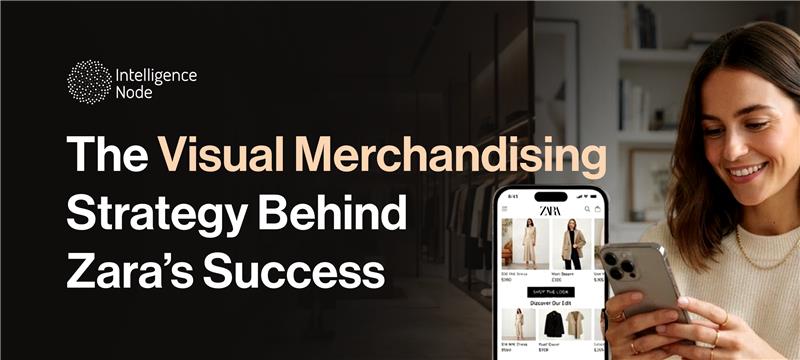
Zara’s product pages carry that same discipline into their content. Photography favors contextual shots, products styled and shown in real settings, over plain studio images. This helps shoppers picture the piece in use instead of judging it in isolation, according to Spyrosoft’s ecommerce UX review, 2026.
Zara pairs that with curated collections and recommendation-driven sections like “Best Sellers” and “The New” rather than a flat product catalog. The approach feels closer to a styled lookbook than a typical fast-fashion listing, as seen on Zara’s own site.
Zara has long chosen store locations deliberately, taking flagship spots next to or near higher-priced, aspirational brands so its own prices read as accessible by comparison. That logic still holds, but the mechanics behind it have changed.
Inditex, Zara’s parent company, closed its most recent fiscal year with 5,460 stores group-wide, 103 fewer than the year before, alongside 190 new openings and 217 refurbishments. This reflects a clear move toward fewer, larger locations rather than store-count growth, FashionNetwork reported.
Zara itself had dropped to roughly 1,495 stores by April 2026, a 15-year low, as less profitable outlets close in favor of larger flagships in stronger locations, MarketScreener found. The real estate logic hasn’t gone away. It’s just expressed through fewer, bigger stores instead of a broad footprint.
The system behind Zara’s in-store consistency is less well known than its pricing logic, and it’s worth understanding for anyone thinking about assortment and merchandising.
Zara’s central merchandising teams in Arteixo build and photograph mock store layouts, then send detailed planograms to stores worldwide to keep the visual experience consistent across markets, Drapers reported.
Much of this work happens inside a mock-up space where nothing is ever actually sold to a shopper; it exists purely to standardize the instructions every store receives.
Paired with that consistency is Zara’s rotation cadence. New, limited runs of stock arrive often and in small batches, keeping the assortment current and creating real scarcity. If a shopper doesn’t buy something this week, it may be gone next week. That combination of centralized visual control and engineered scarcity is the mechanism worth studying, more than the store count itself.
Zara’s rotation-driven scarcity has a real environmental cost. Frequent restocking creates a sense of urgency in stores, but it also means more shipping. As a result, Inditex’s transport emissions reached a record high last year, rising 24% from its 2018 baseline, even as the company works to cut emissions, Bloomberg reported. Good On You’s January 2026 rating also points to this gap, giving Zara 3 out of 5 and finding no evidence that the brand is on track to meet its own targets.
The competitors that mattered a decade ago are gone. Forever 21, once seen as Zara’s direct fast-fashion rival, filed for Chapter 11 bankruptcy in March 2025 and closed its entire U.S. business, a collapse Forbes reported the company tied directly to competition from lower-cost, direct-to-consumer players like Shein and Temu.
That makes Shein and Temu the real comparison set today, and they compete on a different axis entirely: aggressive price undercutting and enormous SKU volume.
Zara’s response, along with Inditex’s own fast-growing brand Lefties, has been to lean harder into what Shein and Temu can’t easily copy: physical retail presence, in-store experience. This means focusing on the real estate logic described above, rather than competing purely on price. For merchandising teams, this is a clear example of curated scarcity competing against volume and price.
Where Zara competes through price-anchored real estate and rotation, high-end department stores compete through curation, service, and increasingly, data. Nordstrom is the clearest example today. In early 2025, the Nordstrom family partnered with Mexican retailer El Puerto de Liverpool to take the company private in a $6.25 billion deal. It marked Nordstrom’s first return to private ownership since 1971. The family holds a 50.1% controlling stake, TheStreet reported.
Nordstrom’s revenue rose 7% in 2025 to $15.9 billion, passing its pre-pandemic 2019 high, according to Fortune. Because Nordstrom no longer files quarterly results as a private company, Fortune reports that figure rather than citing a public filing.
Alongside that growth, Nordstrom has invested in upgrading stores, merging its consumer databases, and expanding inventory depth. This merchandising and data story that lines up closely with what a digital-shelf audience cares about: unified inventory visibility and personalization. It’s about building that experience on a single consumer view, not just visual presentation.
Nordstrom has also gained ground since Saks Global filed for Chapter 11 in January 2026, further cementing its position at the top of the U.S. department store tier, per TheStreet.
In physical retail, Sephora’s open-sell, heavily sampled store format solves a trust problem: letting consumers test a product before buying removes the biggest barrier to purchase in beauty and skincare. Its return policy has always backed that trust, but it has tightened.
As of 2026, Sephora runs a two-tier system: a full refund within 30 days of purchase. Store credit for returns between 31 and 60 days. No returns after 60 days, per The Return Guide and All Return Policies. That’s a shorter window than before. Sephora made the change in April 2025.
Returns and trials are now a measurable part of purchase decisions, not just a cost to manage. Retailers expect 15.8% of annual sales to be returned in 2025, totaling $849.9 billion, down slightly from 16.9% and $890 billion in 2024. The figures come from the National Retail Federation and Happy Returns found in their 2025 Retail Returns Landscape report. Online returns run higher, at an estimated 19.3% of online sales, and the NRF’s research puts fraudulent returns at 9% of the total.
On the consumer side, 82% of shoppers now call free returns a major purchase consideration, up from 76% the year before. And 71% say they’re less likely to shop with a retailer again after a poor returns experience, Chain Store Age reported.
Sephora’s trial tactics aren’t limited to stores. Its return policy runs the same 30/60-day structure online, though the return window starts from the ship date rather than the purchase date. Online orders also come with up to two free samples at checkout, the digital version of in-store sampling.
The AR layer is already live too. Sephora’s Virtual Artist tool lets shoppers try on makeup shades through their phone or computer camera and is credited with a 30% drop in makeup returns. For other digital retailers, that combination, trustworthy returns, sampling, and AR try-on, is a proven conversion lever, not just a Sephora-specific perk.
Out of physical retail, these four mechanics map onto four digital-shelf disciplines. Price architecture and anchoring: Zara’s aspirational-neighbor logic becomes competitive price positioning, knowing exactly where a price sits relative to a defined comparison set and adjusting deliberately rather than reactively.
Assortment velocity and scarcity: Zara’s rotation cadence becomes availability and newness signaling, surfacing what’s new, what’s limited, and what’s about to sell out. This is backed by real inventory data rather than manufactured urgency.
Trial substitutes: Sephora’s in-store sampling becomes reviews, ratings, complete product content, and AR try-on-anything that reduces a buyer’s uncertainty before checkout. Curation and data as loyalty: Nordstrom’s unified consumer view becomes personalization built based on a single source of inventory and pricing truth across channels.
Go deeper: A Detailed Guide to Digital Merchandising for eCommerce Success.
Our Market Intelligence and Product Intelligence capabilities support exactly this: continuous monitoring of competitor pricing, promotions, and assortment across 250+ retailer sites and 200,000+ brands. With 99% product-matching accuracy and refresh rates as fast as every 10 seconds, merchandising decisions are based on trusted, current data instead of manual spot checks.
The biggest new shift for 2026 is traffic that isn’t human at the point of discovery. AI-sourced traffic to U.S. retail sites grew 693% over the November to December 2025 holiday period, according to Adobe Analytics’ own first-party data.That traffic also converts better: in March 2026, AI-sourced visits converted 42% higher than non-AI traffic, a reversal from converting 38% worse the year before. AI sourced traffic also drove 48% longer time on site and 37% higher revenue per visit, Adobe found.
Yet most retailers aren’t ready for it. The same data shows product pages average only 66% visibility to AI models, meaning a third of a typical catalog isn’t even being seen. It’s the same consistency problem Zara’s planograms and Nordstrom’s unified data solve for human shoppers, now extended to machine-readable content.
Visual merchandising has always been about removing friction between a shopper and a decision to buy. Zara does it through real estate and rotation. Nordstrom does it through curation and unified consumer data. Sephora does it through trial and a trustworthy returns policy.
None of these tactics are new; what’s new is the channel. As AI-sourced traffic and agentic shopping take a growing share of retail discovery, the same principles that work on a store floor need to show up in machine-readable product content. They need to be applied just as deliberately as they show up in a Zara planogram. Retailers that bring that same rigor to their digital shelf will be ready for today’s shoppers and tomorrow’s AI agents.
That’s the shift Intelligence Node’s AI Readiness and Decision Intelligence capabilities are built for, structuring catalogs across 350+ categories and 550+ standardized attributes for AI-led discovery. They also turn those signals into recommended action.
See where your digital shelf stands. Request a custom DEMO today!
Traffic to US retail sites from generative AI platforms jumped 4,700 percent year over year, according to Adobe Analytics. Nearly two-thirds of global…
Retail pricing has always been a balancing act: win demand, protect margin, and maintain shopper trust. But in the agentic commerce era,…
Pricing is one of the most important drivers of retail growth. The right pricing strategy helps retailers increase revenue, protect margins, attract…
Back-to-school shopping is one of the biggest retail moments of the year. This golden window goes far beyond notebooks, backpacks,…
Every product decision affects sales, margins, and consumer satisfaction. But many retailers still struggle to balance product availability with inventory efficiency, causing…
From June 2–4, retail's biggest conversations came to Marina Bay Sands, Singapore. Retail industry and tech leaders across the region gathered at NRF 2026: Retail’s Big Show…
This website uses cookies.
