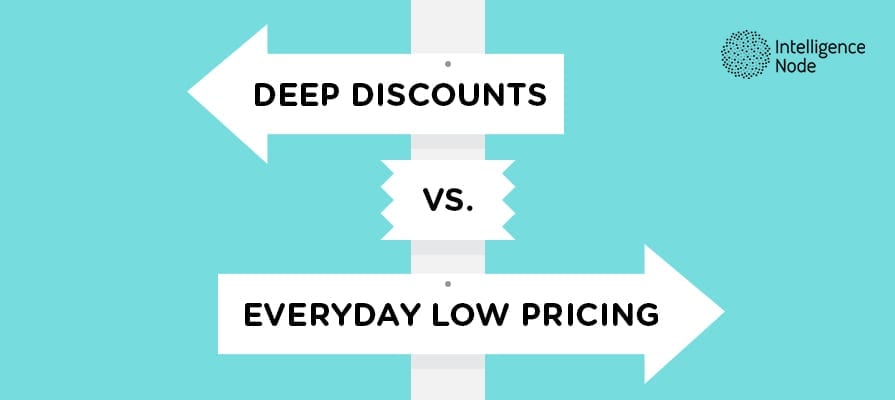
If you’re a retailer in the twenty-first century, chances are that you’ve come across the terms ‘deep discounts’ and ‘everyday low prices.’ Convenience stores, e-retailers, and brick and mortar stores alike face this dilemma; to go with consistently lower prices, or try an ad campaign with occasional sales and promo offers.
In the US, most retailers have been on a roller coaster ride in recent years. This is because a majority of their customers have grown more inclined to save money, rather than splurge on impulse buys. However, despite the evolving buyer behavior, some retailers have been able to stay ahead of the game. The difference in the fortunes of retailers was driven mainly by their individual pricing strategies.
So which retailing strategy are the one customers prefer when they shop at retail stores and websites? Let’s take a look at how these retail pricing strategies compare against each other:
With everyday low pricing strategy, your marketing campaigns and merchandising technologies are both designed to let your consumers know that every single item you sell will be available at a low price, all the time.
“ It takes Amazon two minutes to make a price change! Is your price right?“
This method gives the retailer the advantage of clarity — it’s easy to brand yourself in customers’ minds as an establishment that offers consistently lower prices than your competition. This strategy is sure to pull in consumers who make buying decisions solely based on price. Everyday low pricing also attracts those looking to save money on occasion, such as someone in a temporary financial crunch.
As effective as it is, everyday low pricing strategies have one disadvantage. Consumers who tend to oversimplify things could associate your brand with cheap products. That by itself is okay, but this can often lead to an assumption that you don’t offer high-quality products.
Employing deep discount pricing strategy, retailers set prices higher than their counterparts. However, they use advertising techniques to promote frequent sales with marked-down prices.
This technique, also known as high/low pricing, has made for much more frequent sales than in the past. Before deep discount strategies, prices were only marked down due to excess stock, at the end of the peak season, or when vendors reduced their prices. With today’s increased competition and value-conscious customers, it makes sense to have hugely-hyped and frequent discount sales.
While you won’t be stuck with the “cheap prices and cheap products” label, deep discounts can take a longer time to turn a profit.
Which strategy, as a retailer, would you be better off following? Do you offer consumers consistently lower prices, or put your trust in periodic offers and discount sales?
A recent study published by the Stanford Global School of Business addressed this very issue. Researchers discovered that, while everyday low prices enabled fixed costs for retailers, promo-based deep discount techniques resulted in higher revenues over time.
The authors of the study discourage retailers from regularly depending on deep discounts, or pricing their products based on competitors’ rates. Instead, they suggest pricing consistently.
Consumers seem to prefer a number of smaller discounts over rarer large-value discounts and promotional offers. Simply put, the majority of consumers prefer retailers that seem to offer prices cheaper than the competition on every shopping trip.
For everyday low prices, examples such as Walmart and Costco are indicative. Both of these retail chains rode the low pricing wave in the 1990s. Traditional supermarkets and chains such as Safeway could simply not keep up with the effectiveness of this strategy, letting the lower-priced chains dominate the markets.
A comparison of these strategies shows that, in order to achieve success, retailers should follow this three-pronged approach.
If you’ve chosen to go with everyday low prices, ensure that your establishment delivers on this promise consistently. On the other hand, if you plan on driving sales through promotional events and offers, make sure your products never lack quality.
Make it clear where your marketing strategy’s core lies. Whether it’s low pricing or discounts and offers, everything about your company—including the logo, mission statement, and brand name itself—needs to reinforce this.
Your advertisements, official statements, promotions, and public relations should communicate this promise clearly.
Market conditions are never constant, as any person in the retail world can attest. Customer behavior can change, and so can wholesale prices and competition strategies. But spend effort, time, and resources to ensure that you offer the promised pricing on your entire product range. Real-time pricing analytics software can help you out here.
While deep discount strategies can drive better sales revenue in the long run, the individual customer prefers brands that offer lower prices in the long run.
AI-driven shopping is already changing how retailers think about merchandising. Traffic from AI sources to U.S. retail sites grew 393% year over…
Traffic to US retail sites from generative AI platforms jumped 4,700 percent year over year, according to Adobe Analytics. Nearly two-thirds of global…
Retail pricing has always been a balancing act: win demand, protect margin, and maintain shopper trust. But in the agentic commerce era,…
Pricing is one of the most important drivers of retail growth. The right pricing strategy helps retailers increase revenue, protect margins, attract…
Back-to-school shopping is one of the biggest retail moments of the year. This golden window goes far beyond notebooks, backpacks,…
Every product decision affects sales, margins, and consumer satisfaction. But many retailers still struggle to balance product availability with inventory efficiency, causing…
This website uses cookies.

