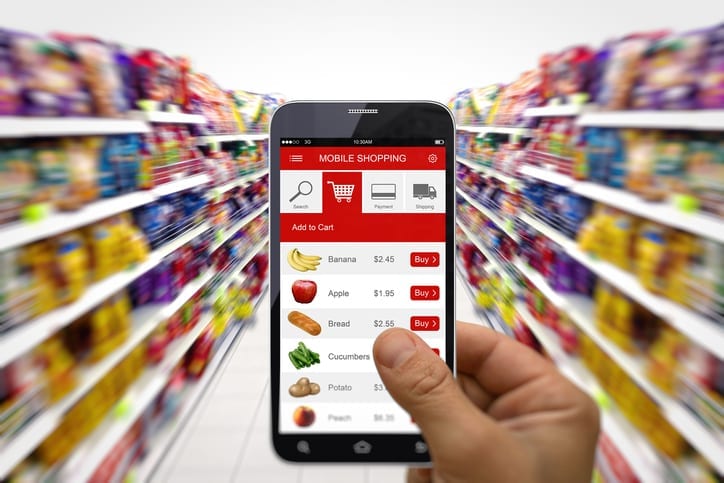
Although the overwhelming majority of grocery shopping currently takes place in physical stores, experts suggest this pattern will change in the next decade, as grocery eCommerce is poised to boom in the next decade.
In the U.S., online grocery shopping could grow five-fold to $100 billion by 2025, according to new research by Food Marketing Institute and Nielsen.[i] Online grocery spending could grow from 4% in 2016 of total U.S. food and beverage sales ($20.5 billion) to as much as a 20% share ($100 billion).[ii]
Currently, a quarter of American households buy some groceries online, up from 19% in 2014, and more than 70% will embrace online food shopping within 10 years. Among consumers who say they will buy groceries using eCommerce, 60% expect to spend a quarter of their food dollars online in 10 years.[iii]
Compared to other countries, the U.S. lags in online grocery shopping because Americans’ online shopping expectations have been set by Amazon, according to experts. U.S. consumers see online shopping as a way to buy individual items rather than baskets of goods on a regular basis.[iv]
Amazon’s disruptive approach to grocery includes a click-and-collect offering. Amazon will soon open 4 stores in Seattle and Silicon Valley where customers can pick up online grocery orders within a 15-minute to 2-hour time window. Customers can also order products in-store using electronic tablets, then wait in a “retail room” while their orders are filled.
In addition, the eCommerce giant offers Amazon Go’s checkout-free grocery shopping and Amazon Prime’s eCommerce membership platform, which includes private label groceries.[v]
Despite consumer behavior shaped by Amazon’s eCommerce dominance, the U.S. market is poised for massive growth. Experts say U.S. online grocery sales jumped 157% in 2016.[vi]
The top market for grocery eCommerce is South Korea, where online sales account for 16.6% of the fast-moving consumer goods (FMCG) market. The top 10 markets and their estimated eCommerce share of the FMCG market are:
More than any other cohort, millennial shoppers are more willing to buy groceries online. Tech-savvy millennial shoppers seem to appreciate the convenience of retailers’ delivery and click-and-collect – buy online and pick up in store – service.[viii]
A new study by Clavis Insight shows 66% of millennials now shop online weekly for groceries. In addition, 69% of millennials purchase health and wellness products online at least once a month, and 25% make weekly purchases of pet food online.[ix]
To attract millennial shoppers, grocery retailers need to offer a seamless mobile-friendly experience, as more than 40% of millennials primarily use a mobile device for shopping.[x]
In general, 3 in 5 grocery shoppers today are looking for sales or coupons on their mobile devices before entering the store and half will use mobile apps to shop at the store.[xi]
Shoppers generally spend more per visit when grocery shopping online than they do during a trip to a physical store. In the U.K., for example, the average online purchase is $59 compared with $15 in-store.[xii]
Consumer loyalty adds to the business case for grocery eCommerce. Kantar Worldpanel data also shows that 55% of online grocery shoppers have entrenched habits. These shoppers repeatedly buy the same brands from the same merchants.[xiii]
To compete effectively, retailers will prepare to offer online shopping. Research predicts that center store product categories, including canned goods, condiments and spices will shift faster to online than perimeter categories, like fresh produce and meats.[xiv] Consider starting small with center store categories and adding more items over time.
Use competitive data to better understand consumer trends. For instance, Intelligence Node’s competitive data includes these insights for the UK grocery market comparing November 2016 to December 2016, where:
Create a strategy based on the competitive analytics and insights, including how these trends relate to shoppers’ online behavior and willingness to use eCommerce for grocery.
Integrate grocery eCommerce into your value proposition, including the convenience and time savings of click and collect programs and home delivery. Work with your suppliers to uncover ways to keep the supply chain cost-effective and responsive to changing consumer needs. By planning ahead now, your company will be well-positioned to capitalize on the imminent growth in grocery eCommerce.
Intelligence Node helps brands and retailers make decisions about the right trends of any product across the globe, at the right time. If you’d like to see how we do that, talk to us today.
———————————————————————————————————————————–
[i]Online grocery sales set to surge, grabbing 20 percent of market by 2025. CNBC. January 30, 2017.
[ii] Ibid.
[iii]Ibid.
[iv]Online grocery sales top $48 billion worldwide. Internet Retailer. October 6, 2016.
[v]Amazon strikes again: E-commerce giant to open click-and-collect groceries. Food Dive. February 24, 2017.
[vi]Online grocery sales top $48 billion worldwide. Internet Retailer. October 6, 2016.
[vii] Ibid.
[viii]Online grocery sales set to surge, grabbing 20 percent of market by 2025. CNBC. January 30, 2017.
[ix]Most millennials grocery shop online. Here’s how to get them into stores. Food Dive. February 24, 2017.
[x]Ibid.
[xi]Online grocery sales set to surge, grabbing 20 percent of market by 2025. CNBC. January 30, 2017.
[xii]Online grocery sales top $48 billion worldwide. Internet Retailer. October 6, 2016.
[xiii] Ibid.
[xiv]Online grocery sales set to surge, grabbing 20 percent of market by 2025. CNBC. January 30, 2017.
Constant shifts in consumer behavior are translating into outsized business impact: from missed conversions and slower inventory turns to weaker margins. Shopping is no longer simple or linear; consumers move between…
According to McKinsey, retailers that lead in digital product execution grow 2x faster than their peers. In today’s hypercompetitive market,…
The 2025 holiday season is around the corner. And it comes at a time where economic uncertainty looms over our…
Optimizing the digital shelf means making sure your products show up where shoppers search and buy, especially when you’re leveraging…
We may still be weeks away from the holiday rush, but smart retailers know now is the time to start…
Intelligence Node is proud to be the Official Awards Sponsor for the Women Leaders Summit & Awards India 2025, taking…
This website uses cookies.


