According to McKinsey, retailers that lead in digital product execution grow 2x faster than their peers. In today’s hypercompetitive market, that growth is not driven by flashy marketing or aggressive discounting alone, it is driven by how accurately and consistently products show up across every touchpoint. From product discovery to conversion, execution is everything.
The digital shelf does not forgive broken data. What looks like 25,000 SKUs on paper quickly explodes into hundreds of thousands of localized, channel-specific product listings, each requiring distinct titles, specifications, high-resolution imagery, compliance tags, variant logic, and time-sensitive promotional pricing. One outdated description or missing attribute is all it takes to lose the sale, lower your search rank, or trigger a return.
In this environment, clarity, speed, and scale are non-negotiable. And the only way to achieve that is through a tightly integrated, modern Product Information Management (PIM) system.
This article will define PIM, explore why it matters to both retailers and manufacturers, and highlight the features that make a PIM scalable, reliable and future ready. Let us decode the vitality of PIM for retailers and manufacturers:
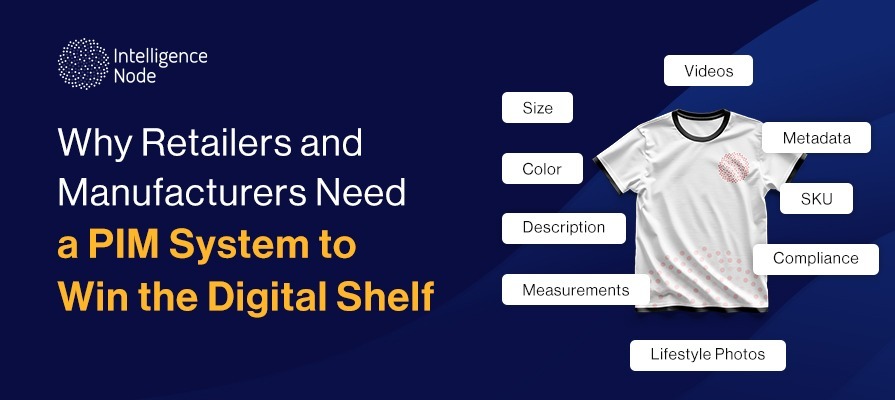
A PIM system is your master repository for every piece of product content you own or distribute. That includes everything from technical specifications and metadata to marketing images, videos and compliance certificates. It is built to connect multiple teams and data sources and to ensure that nothing breaks on your channel feeds or classification structures.
Here is why every modern or growing organization needs a PIM:
Retailers live or die on customer experience and speed. A modern PIM helps eliminate weak spots in both areas.
Thirty thousand SKUs from dozens of vendors create chaos without a PIM. Data formats, attribute naming conventions and image specifications vary widely. A PIM normalizes everything so product content is consistent and ready for global syndication.
When campaigns, flash sales or new collection launches happen, retailers cannot afford delays. A PIM for retailers allows bulk updates, structured enrichment and push to every channel in hours instead of days or weeks.
Marketplaces favor structured, complete product data. PIM for retailers enhances titles, bullet points, images and spec completeness. That leads to improved rankings, search visibility, add-to-cart rates and SEO gains.
Product details that mismatch buyer expectations lead to returns and negative reviews. A PIM for retailers and manufacturers ensures the information is correctly structured and validated, leading to happier customers, fewer returns and a healthier bottom line.
Manufacturers often work with outdated content tools, limited governance and weak workflows. A PIM software for manufacturers transforms how they bring products to market.
All technical information, assets and approvals flow through one controlled source. Global compliance becomes consistent, and manual errors are eliminated.
Shared Excel files and emailed CSVs become outdated whenever files get copied or renamed. Once product data lives in a PIM, changes propagate in real time, with version history and edit control.
Retailers, distributors, marketplaces, eCommerce platforms and back-end systems can all be supplied from a single source. That eliminates CSV hand-offs and improves speed and accuracy.
New products can go live across channels within hours because data is enriched, approved and formatted in a unified environment. That drives faster revenue velocity and competitive advantage.
A PIM for retailers and manufacturers sits at the center of your digital commerce stack. Several technical capabilities set apart effective systems from ones that cannot scale.
A strong PIM for retailers uses AI to detect missing fields, inconsistent formats or even classification errors. Suggestions for completion reduce manual effort.
You should be able to update price lists, tags, or metadata across tens of thousands of SKUs collectively. Everything is versioned, auditable and reversible.
Native integrations or connectors for platforms like Amazon, Shopify, Walmart, Target, and Magento remove the need for CSV bridges and manual mapping.
Global brands must manage language, weights, measures, and pricing logic across regions. A PIM system built for localization handles this seamlessly.
Product changes typically involve many teams. A role-based permission architecture prevents accidental leaks or regression and provides end-to-end accountability for every update.
PIM for retailers is not an IT checkbox. It is the operational layer that decides whether your product content scales or stalls. Every missed field, duplicate SKU, or broken spec sheet is a compounding liability in multi-channel commerce. A modern PIM makes sure that never happens. It removes friction at scale, whether you are updating 500 products or 50,000, and it’s foundational to winning a digital shelf.
Here’s what it actually delivers:
When your team no longer wastes time fixing spreadsheets or reloading feeds, output increases. Bulk updates apply across all platforms. AI validations reduce human input, whereas syndication happens in minutes.
Buyers do not convert on uncertainty. Inconsistent specifications, missing dimensions, or pixelated images kill trust. PIM for retailers fixes that at the source. It pushes verified content to every channel, keeping what the consumers see aligned with what they receive.
Every unchecked field is a future issue. PIM for retailers and manufacturers enforces data governance through rules, not post-launch cleanups. No more returns due to size mismatches or content discrepancies.
When new SKUs, vendors, or regions come in, spreadsheets break. On the brighter side, PIM for retailers doesn’t. Whether you’re adding 10 products or scaling to 100,000, the infrastructure stays intact. Operations do not slow down with growth.
Seasonality in commerce is not just about peak periods like holidays or back-to-school seasons. It is about how fast your team can align product content, pricing, imagery, and promotional messaging across every customer-facing channel, without restarting the entire workflow each time.
A modern PIM system for retailers and manufacturers enables this speed by maintaining prebuilt localization rules, language templates, and regulatory compliance frameworks across regions. Whether the campaign is a flash sale on a regional DTC site or a global product launch across Amazon, Flipkart, and Carrefour, the same master data can be adapted and deployed in minutes, and not days.
The PIM for retailers and manufacturers supports:
This flexibility ensures that your campaigns are not delayed by internal processes or siloed teams. Instead, they move with the market and reach the customer when interest is highest.
PIM success should not be measured by system logins or dashboards used. It should be measured by how quickly you launch products, how few post-launch corrections your teams need to make, and how reliably data flows to every channel. Here are two real-world examples that cut through the noise and show exactly what changes when the right PIM is in place.
A mid-sized U.S. retailer struggled every quarter to sync listings before big seasonal pushes. Their product data came fragmented from over a dozen vendors, with no consistent formatting or validation logic. They brought in a modern PIM and rewired how product content moved through their business.
Within 3 weeks:
Impact: The go-live took less than 7 days. There were no duplicate entries and no custom templates for each channel. Conversion rates jumped 11.4%, driven by accurate descriptions, clean imagery, and real-time inventory-tagged promotions.
A global industrial manufacturer needed to fix how product data reached its downstream distributors. Localized specifications, updated safety instructions, and pricing changes were bottlenecked in email threads and spreadsheets. Their PIM changed that.
With full implementation:
Impact: What used to take 3 weeks now takes hours. Support tickets from distributors for outdated or incorrect data dropped by 85%. No more chasing partners. No more inconsistencies.
This is where the difference shows. Not on a roadmap, but on your P&L and operational metrics.
These outcomes are not anecdotal. They are quantifiable shifts in how quickly, cleanly, and consistently your business operates with a structured, centralized PIM strategy.
You can invest in the best PIM platform on the market, but if your input data is flawed, every output suffers. Your product listings will still carry mismatches, your enrichment workflows will be stuck in manual loops, and your teams will be fixing, not scaling. This is where Intelligence Node acts as the upstream layer, the safeguard that ensures what enters your PIM is already clean, structured, and market-ready.
With Intelligence Node, data validation is not reactive. It is built into the foundation.
Intelligence Node delivers product-matching accuracy at scale. Whether it is Amazon, Walmart, Zalando, or Flipkart, the platform recognizes and maps products at the variant level with 99% accuracy. This means your PIM receives ready-to-use records.
What it solves:
Product enrichment has long been one of the most time-consuming tasks inside any PIM environment. Intelligence Node uses proprietary AI to detect missing attributes, suggest relevant tags, and auto-fill enrichment fields that conform to your taxonomy.
Especially critical for:
For retailers, Intelligence Node does more than clean internal data. It overlays real-time competitor data side by side, feeding into your PIM for strategic benchmarking. The result is smarter merchandising and pricing decisions right inside your product data workflows.
Direct benefits:
If you are a manufacturer, brand protection is non-negotiable. Intelligence Node tracks how your SKUs are represented across all distributors and marketplace partners. If something changes, from specifications to compliance info to MAP pricing, you are notified.
What this protects against:
Whether your team is using Salsify, Akeneo, inRiver, or a custom-built PIM, Intelligence Node integrates with your workflow through an API-first architecture. No middleware. No delays. Just clean, enriched product data flowing directly where it needs to go.
Supported environments include:
This integration ensures that your PIM is not another silo. It becomes the control center powered by live, validated market data.
Buying a PIM system is not just about solving today’s problems. It is about building infrastructure that scales with your product catalog, team complexity, and market footprint. This decision impacts your time-to-market, campaign agility, and cross-border execution. Choose wrong, and you are looking at rework. Choose right, and you build a system that supports growth with minimal overhead.
The right PIM should accommodate rapid changes in business, whether it is a sudden SKU spike, a new marketplace, or onboarding a new vendor channel.
Check for:
Your PIM is only valuable if it connects deeply with the systems that manage fulfillment, content, pricing, and customer experience. Disconnected tools only create more data silos.
Must integrate with:
Batch uploads and spreadsheet connectors are not enough. Look for live APIs with full read-write capabilities and webhook support for real-time sync.
You should not need a six-month onboarding just to go live. A good PIM vendor has done this before; they bring playbooks, templates, and training that shorten ramp-up time.
Evaluate:
A proven vendor brings experience from similar rollouts — they know what fails, what scales, and what gets messy at 10,000+ SKUs. Do not be the test case.
Ask for:
You are not buying a tool. You are choosing a partner who will shape your digital backbone for the next five years.
Surface the operational truths early. Do not settle for generic demos.
These are the questions that separate a scalable platform from a fragile one.
The brands and retailers winning on the digital shelf today are not always the loudest or the cheapest. They are the ones with the most control. Control over product content. Control over syndication velocity. Control over accuracy, compliance, and scalability.
A purpose-built PIM system gives you that control. It does not sit in the background. It drives time-to-market, drives campaign readiness, and protects your reputation across every sales and discovery channel.
When powered by Intelligence Node, your PIM evolves into a real-time, insight-driven foundation. It no longer waits for clean data; in fact, it receives it. It doesn’t react to changes, as it executes them. Connect with us and let the shelf work for you. Not the other way around.
Competitive price intelligence is the process of researching, gathering, analyzing, and acting on pricing data from competing organizations, including how…
Holiday shopping trends of 2026 point to a clear pattern: online growth is outpacing overall retail. According to Deloitte, eCommerce…
AI-driven shopping is already changing how retailers think about merchandising. Traffic from AI sources to U.S. retail sites grew 393% year over…
Traffic to US retail sites from generative AI platforms jumped 4,700 percent year over year, according to Adobe Analytics. Nearly two-thirds of global…
Retail pricing has always been a balancing act: win demand, protect margin, and maintain shopper trust. But in the agentic commerce era,…
Pricing is one of the most important drivers of retail growth. The right pricing strategy helps retailers increase revenue, protect margins, attract…
This website uses cookies.

