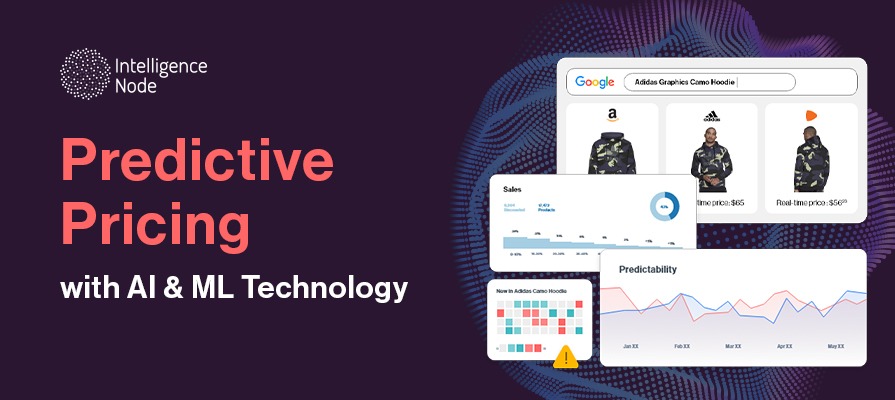
Today’s digital retail landscape is increasingly competitive, and the ability to predict and proactively respond to market changes has become the need of the hour. Traditional pricing strategies, which are often reactive and based on historical data, can leave retailers a step behind, especially in a fast-paced, saturated market. In contrast, predictive pricing represents a massive leap in pricing optimization strategy, employing a future-proof approach that empowers retailers to stay ahead of the curve, and never fall behind competitors. The global retail technology market is growing rapidly, and is forecasted to reach $388.51 billion by 2026, with more retailers opting for advanced solutions to stay competitive in digital commerce.
Predictive pricing sets itself apart by integrating a vast spectrum of data inputs, including real-time consumer behaviors, competitor pricing, and broader market movements. This comprehensive approach provides a more holistic view of the market, leveraging advanced technology to work with large-scale granular data, and enabling predictive models to anticipate shifts and adjust prices proactively. Unlike traditional methods that might rely on slower, manual recalibrations, predictive pricing systems are built on dynamic, self-updating models that learn and adapt continuously. This capability ensures that pricing strategies are optimized for every conceivable scenario, allowing retailers to make quick, impactful adjustments to pricing in real time.
Here, predictive pricing acts as a strategic asset that dynamically synthesizes diverse data points to foresee and capitalize on such market trends. In 2024, this technology is more accessible than ever, and retailers leveraging these models can adjust their pricing strategies in advance, optimizing sales and maximizing profits by reacting instantly to market shifts. In today’s high-stakes arena of online retail, where pricing often dictates whether a consumer will purchase from one retailer over another, this ability to adjust prices swiftly and smartly is crucial.
Predictive analytics utilizes a blend of data analysis, statistical algorithms, and machine learning techniques to forecast future market behaviors based on historical data. This approach is instrumental in decoding complex market dynamics and customer behaviors, allowing businesses to make strategic decisions with a higher degree of accuracy. This is particularly significant in environments where global players like Amazon alter prices up to 2.5 million times a day, and pricing strategies can vary vastly throughout the calendar year, with shifting promotions, varying discounts or high volume sales periods, and rapidly changing consumer trends changing market dynamics constantly.
These technologies can process vast amounts of data rapidly —from historical sales and promotions to external factors like market shifts and competitor data—to make informed pricing decisions. By applying sophisticated algorithms, retailers can uncover patterns and insights that human analysis could not feasibly detect, making pricing strategies smarter and more reactive to the shifting market landscape.
To achieve this, predictive pricing models integrate methods like data mining, AI, and machine learning to analyze past pricing data and consumer responses, thus enabling retailers to forecast the optimal price points that maximize sales and customer satisfaction.
AI and ML are the technological backbones that drive predictive pricing. These technologies enhance the accuracy of pricing models and allow for scalability across different product lines and markets without a corresponding increase in manual oversight. In predictive pricing, AI models simulate potential market scenarios and predict outcomes based on different pricing strategies. ML algorithms learn from each iteration, improving their forecasts with each cycle. This self-improving capability is crucial for adapting to the fast-changing retail environment.
These models not only allow for competitive pricing adjustments in real-time but also provide insights into customer preferences, helping retailers to tailor discounts and promotions effectively and enhance overall profitability. Through predictive pricing, retailers can strategically adjust to market demands, ensuring both competitive advantage and customer loyalty in a highly dynamic retail environment.
With accessible retail technology readily available, organizations can now combine external data sources like customer preferences and market trends with internal criteria such as product availability, brand guidelines, price elasticity limits, and more to build accurate price models that adapt in real-time. However, the effectiveness of predictive pricing heavily depends on the quality and variety of data used. High-quality data is accurate, comprehensive, and timely. Typical data sources include sales data, promotional calendars, competitor pricing, customer feedback, and macroeconomic indicators. Ensuring data integrity and continuous updates is vital for maintaining the accuracy of predictive models.
Predictive pricing strategies are best executed with advanced retail intelligence solutions such as Intelligence Node, to ensure maximum impact and returns. Our platform boasts record-breaking 99% accurate product matching capabilities, enabling businesses to make precise comparisons and informed decisions swiftly. This precision is further enhanced by our global to zip code level scalability, allowing organizations to tailor their pricing strategies to specific market dynamics effectively. Our solutions are designed for ease of use, featuring custom dashboards and plug-n-play APIs that facilitate rapid integration and adaptation to meet specific operational needs. This user-friendly approach, combined with robust analytical capabilities, ensures that businesses are always ahead of the market curve. These features are essentials for businesses aiming to leverage predictive pricing effectively, driving profitability and market responsiveness.
For a closer look at Intelligence Node’s price optimization solutions, book a demo today.
In the near future, AI and ML are poised to deepen their impact in the retail sector by enabling more personalized pricing strategies. Tomorrow’s pricing solutions could dynamically adjust prices at an individual level, based on consumer behavior patterns and preferences detected through data. Additionally, AI-enhanced predictive analytics will likely better anticipate market disruptions, adapt to economic shifts more rapidly, and even predict the effects of global events on local pricing strategies. This will empower retailers to not just react but be proactively resilient in their pricing approaches.
Retailers who embrace these innovations can not only anticipate market trends more accurately but also respond to consumer needs with greater agility. As retail technology advances, integrating AI and ML into retail pricing strategies is becoming essential for those aiming to lead in a data-driven marketplace. By doing so, brands position themselves at the forefront of the industry, ready to capitalize on data-driven insights for optimized pricing decisions that drive profitability and market success.
Next Read : Savvy Shoppers & the Rising Need for AI Pricing Solutions
Constant shifts in consumer behavior are translating into outsized business impact: from missed conversions and slower inventory turns to weaker margins. Shopping is no longer simple or linear; consumers move between…
According to McKinsey, retailers that lead in digital product execution grow 2x faster than their peers. In today’s hypercompetitive market,…
The 2025 holiday season is around the corner. And it comes at a time where economic uncertainty looms over our…
Optimizing the digital shelf means making sure your products show up where shoppers search and buy, especially when you’re leveraging…
We may still be weeks away from the holiday rush, but smart retailers know now is the time to start…
Intelligence Node is proud to be the Official Awards Sponsor for the Women Leaders Summit & Awards India 2025, taking…
This website uses cookies.
