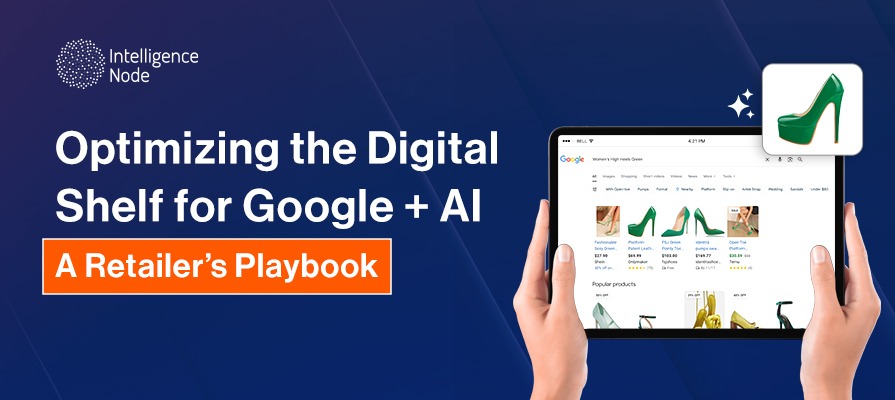
Optimizing the digital shelf means making sure your products show up where shoppers search and buy, especially when you’re leveraging both Google and AI to drive visibility and engagement. For retailers today, this often involves enhancing digital shelf presence, using AI-driven search to surface the right product at the right time, and integrating Google commerce tools so your items appear in the places consumers trust.
A recent report found that 64% of shoppers used AI-powered tools to discover new products in the past year, meaning that optimizing your products for AI search can make a direct difference. Generative AI services also drove a 4,700% increase in eCommerce site traffic from year‑over‑year in July 2025. Plus, listings using AI‑powered search and recommendation systems saw a 34% increase in search conversions. Using tools like Intelligence Node, retailers can manage product matching, enriched metadata, and real-time updates to maintain consistent visibility and recommendation readiness across every channel.
In this playbook, you’ll learn how to combine Google visibility and AI capabilities, so your products not only appear but also convert, helping your digital shelf perform like both a storefront and a recommendation engine.
Every day, countless shoppers begin their journey online, making the importance of the digital shelf more critical than ever. The moment your products appear in the right place, you win the first game of attention. To capture that attention, you need to leverage Google visibility, as over one-third of online shoppers initiate their searches there, and products with strong Google placement often drive higher traffic.
At the same time, the role of AI in guiding shoppers’ purchases is growing, as 58% of consumers say they have replaced traditional search engines with generative AI tools such as ChatGPT for product recommendations. Today’s digital shelf must also be optimized for AI systems that interpret, recommend, and personalize product data across search engines, marketplaces, and conversational platforms.
Here’s why:
Optimizing for both ensures your brand isn’t just found, it’s chosen.
A future-ready digital shelf balances search intent and machine understanding, combining the precision of SEO with the intelligence of structured data. The following sections explore two key pillars you should build into your content strategy:
To capture the human-driven moments when shoppers search, you must focus on the following:
ChatGPT now receives over 84 million shopping-related questions each week in the U.S., and globally, it handles around 2.5 billion prompts daily. This massive volume shows just how quickly consumers are turning to AI for product discovery, pricing, and recommendations.
As algorithms grow smarter, you also need to feed machine systems with clean, structured content to win in recommendation engines and AI search. For example, Walmart is already working with OpenAI to allow shoppers and Sam’s Club members to purchase directly through ChatGPT via “Instant Checkout”, signalling a major shift in conversational commerce. In fact, a recent analysis shows that the share of chat‑shopping queries within ChatGPT grew from about 7.8 % to 9.8 % of total prompts between January and June 2025, meaning shopping‑related conversations within AI interfaces are doubling in relative size.
This rapid growth highlights that more consumers are now asking AI tools directly about products, pricing, and availability, making it critical for brands to ensure their product data is machine-readable and optimized for AI-driven discovery. Here’s what to focus on:
When your brand treats the digital shelf as more than a static brochure, it becomes an active part of your growth strategy. Two powerful systems then work together to create a measurable impact. To begin with, Google prioritizes relevance, letting your product listings capture shoppers’ attention first. Plus, AI detects context, turning your structured data into meaningful recommendations that reach the right customer at exactly the right moment.
That dual optimization unlocks these key benefits for your brand:
In fact, research indicates that global AI software spending in the retail market is forecast to rise 15.8% in 2024 to $7.8 billion and reach $12.5 billion by 2027, highlighting the urgency for retailers to prioritize AI-fueled visibility to stay competitive.
Your digital shelf must perform like a well‑oiled engine and act as both a storefront and an intelligent guide. When you bring together search intent and machine understanding, you create the environment where products get found, clicked, and purchased.
Making your products discoverable and recommendable across every shopper touchpoint requires careful attention to both data and presentation.
When your product catalog lacks detail, your AI‑powered discovery tools simply won’t perform at full strength. Every missing or incorrect attribute diminishes the chance that you’ll show up in search or get recommended via your digital shelf. Recent research shows that 88 % of online shoppers compare products before purchasing, and incomplete or inconsistent product attributes drive 53 % of customers to abandon carts. As a real-time data intelligence platform, Intelligence Node uses its advanced product-matching engine to capture and update detailed attributes, images, descriptions, and pricing in real-time, giving retailers a clear view of market trends.
In fact, a global fashion retailer using Intelligence Node’s product matching achieved average sales growth of 3 % and gained 2‑3 % market share across 14 countries.
With clean, structured, and enriched product data powered by Intelligence Node’s product matching, your listings stand a far better chance of being found by the right shopper and converting consistently. Structured data also allows AI tools, recommendation engines, and chatbots to accurately interpret your products and present them to the right audience with confidence.
Audit your PDP content with AI-led content management
Your product copy needs to speak like a real person because AI now understands natural language and shopper intent. Optimizing only for generic keywords like “wireless headphones” no longer guarantees visibility.
Intelligence Node encourages brands to use conversational, intent-driven phrases such as:
These phrases increase discoverability across voice search, chatbots, and AI-powered shopping assistants, while also reflecting how real shoppers ask questions. Studies show that 87% of consumers avoid repeat purchases if product descriptions are inaccurate, and 85% consider product information and images critical when choosing brands or retailers.
Intelligence Node’s AI-driven content optimization platform automatically audits, corrects, and optimizes PDP content. The system uses generative AI to produce human-like text and images based on top-ranking competitors and a database of 1.2 billion SKUs, ensuring listings remain SEO-friendly, descriptive, and visually appealing.
Each online platform interprets and ranks product data differently, so retailers must adapt their strategies to each platform to maximize visibility and sales. For example:
Intelligence Node supports platform-specific optimization by continuously updating your product attributes, pricing, and descriptions, while applying advanced product matching and enrichment techniques.
The future of retail belongs to brands that speak both human and machine fluently. Building optimized Product Detail Pages (PDPs) for both search engines and AI helps your products get noticed, understood, and chosen by shoppers.
When your metadata is detailed and your product data is structured, your offerings become readable by machines and appealing to shoppers.
Tools like Intelligence Node help manage your product listings across pricing, assortment, and content so your offerings stay visible and ready across every channel. Ready to bring your brand’s data to life? Book a demo today and start turning your product catalogue into a discoverable, recommendable asset.
Constant shifts in consumer behavior are translating into outsized business impact: from missed conversions and slower inventory turns to weaker margins. Shopping is no longer simple or linear; consumers move between…
According to McKinsey, retailers that lead in digital product execution grow 2x faster than their peers. In today’s hypercompetitive market,…
The 2025 holiday season is around the corner. And it comes at a time where economic uncertainty looms over our…
We may still be weeks away from the holiday rush, but smart retailers know now is the time to start…
Intelligence Node is proud to be the Official Awards Sponsor for the Women Leaders Summit & Awards India 2025, taking…
Introduction: The Importance of Taxonomy Mapping What is Product Taxonomy? Key Concepts & Definitions Why Marketplaces Differ: Amazon, Walmart, Target…
This website uses cookies.



