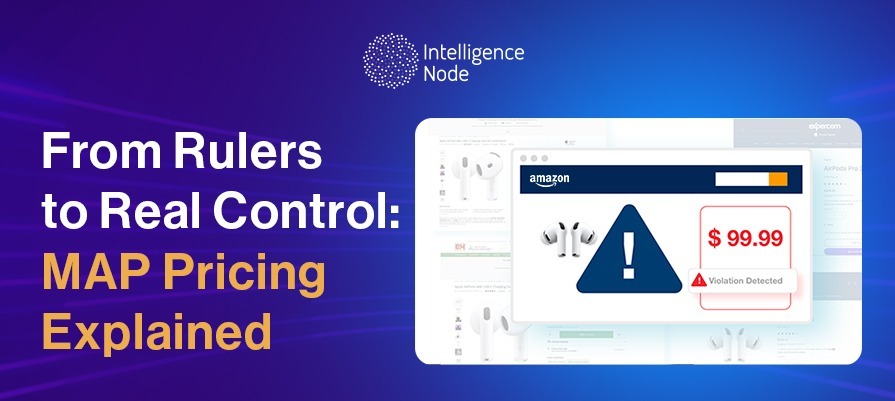
In the past decade, retail has evolved rapidly, opening numerous new opportunities for brands and retailers. Technology has further extended the limits of retail and enabled eCommerce adoption. Rapid eCommerce growth has led to the expansion of marketplaces and resellers. While these have enabled brands and manufacturers to reach a wider audience, they have also led to an increase in unauthorized sellers, counterfeit goods, and Minimum Advertised Pricing (MAP) violations.
In fact, the concerning number of unauthorized sellers (53%) routinely advertise products below a brand’s minimum advertised price. This creates market confusion and puts pressure on your distribution network.
It can be a disadvantage for retailers to sell their products at lower prices than those set by brands. It can also damage the brand’s reputation. To control excessive price variations, protect brands from predatory pricing, and secure equal opportunities for all players in the retail industry, MAP pricing was introduced.
Ready to understand what MAP pricing is, why it matters, and how to build a policy that actually helps your pricing strategy? Let’s get started.
MAP (Minimum Advertised Price) is the lowest price a reseller is allowed to advertise a product publicly. MAP pricing gives brands control over advertised prices while still letting retailers set the final selling price. MAP is set solely by the brand or manufacturer, without negotiation from retailers or distributors.
For example, if an electronic brand sets the Minimum Advertised Price for a particular cell phone model at $100, retailers and resellers, both online and in-store, are obligated to advertise this product at $100 or more.
The goal is simple: to protect your brand’s value by assuring your products aren’t advertised at bottom-dollar prices.
1. Keeps Your Brand Premium, Not Constantly Discounted
Consistent advertised pricing protects perceived value and prevents products from looking cheap or over-discounted.
2. Controls What’s Advertised, Not What’s Sold
MAP governs public pricing, not the final checkout price. Retailers can still offer in-cart deals or loyalty perks while being compliant.
3. Prevents Price Wars Across Channels
Without MAP, one aggressive discount can trigger a race to the bottom. Brands like Nike, Levi’s, Prada, etc., focus on brand experience and positioning, not constant price cuts.
4. Brings Stability to Online Marketplaces
Stable advertised pricing reduces sudden undercutting, especially on marketplaces like Amazon, where price visibility is immediate and widespread.
5. Strengthens Retailer Confidence and Partnerships
When margins are protected, retailers are more willing to invest in promotion, inventory, and long-term collaboration.
1. Retailer Resistance Due to Restricted Pricing Flexibility
Retailers may push back against strict MAP policies because they limit promotional freedom and discount strategies. This can create channel friction and impact long-term distributor relationships.
2. High Enforcement Complexity Across Marketplaces and eCommerce Channels
Monitoring retail MAP pricing among marketplaces, reseller websites, and cross-border listings is operationally demanding. Violations can scale quickly without structured oversight.
3. Legal and Antitrust Risks if MAP Policies Are Poorly Structured
Improperly drafted MAP policies may be interpreted as resale price maintenance or price fixing. Regulatory scrutiny varies by region, complicating compliance. Brands must also use consumer data ethically while enforcing compliance so as to elude legal and reputational risks.
4. Greater Operating Costs Without Automated MAP Price Monitoring Software
Tracking advertised prices manually is labor-intensive, expensive, and inefficient. Without automation, brands face delayed detection of violations and inconsistent enforcement.
5. Limited Control Over Final Selling Price Beyond Advertised Listings
MAP governs advertised prices, not the final checkout price. Retailers may use coupons, cart discounts, or bundles to bypass visible pricing restrictions.
To build a compliant pricing strategy, understanding MSRP vs. MAP price is important for protecting long-term brand equity.
While traditional MAP covers advertised pricing over all channels, IMAP focuses on digital places where prices are instantly visible, easily compared, and frequently updated.
Traditional MAP policies were built around offline ads such as print, TV, or radio. eCommerce introduces added complexity as a result of real-time pricing, automated repricing tools, marketplaces, and performance marketing. IMAP frameworks deal with these digital-specific risks.
IMAP policies commonly include provisions for:
• Search and paid advertising
• Marketplace listings and third-party sellers
• Social media and influencer promotions
• Coupon visibility and promo codes
• Dynamic pricing and retargeting ads
In practice, enforcement consequences under IMAP are often similar to MAP. However, monitoring and compliance tend to be far more complex in digital channels, varying by manufacturer, product category, and geographic market.
MAP policies are primarily used by brands in luxury, technology, and specialty goods that rely on premium positioning. These brands implement MAP to:
An effective MAP enforcement shifts the focus from price-cutting to value-added competition, providing long-term brand health and retailer sustainability.
In the United States, MAP policies are generally permissible under federal antitrust law when structured as unilateral policies that regulate advertised prices, not the final resale price.
To remain compliant, brands must implement MAP independently, avoid negotiated pricing agreements with resellers, and enforce the policy based on clearly defined internal criteria. When properly designed, MAP does not constitute illegal price fixing under the Sherman Act.
In contrast, the European Union and the United Kingdom take a stricter approach. Pricing practices that restrict how retailers advertise prices may be treated as resale price maintenance and can violate competition law.
Keeping consistent pricing can be hard for brands selling through different channels, especially in a highly challenging online marketplace. MAP pricing compliance makes sure that resellers advertise products at or above the minimum price set by the manufacturer. This helps protect margins and brand value.
Violations can bring in serious consequences for resellers, such as warnings and possible account termination if they keep breaking the rules.
Brands must communicate policies clearly and enforce them consistently. Resellers, in turn, should use monitoring tools and do internal checks to make sure that every staff member involved in pricing and advertising knows the current MAP guidelines.
Manual checks are not enough. Brands need systems across retailer websites, online marketplaces, or third-party sellers. AI-driven MAP monitoring software can continuously scan and track prices at the SKU level and capture proof of violations.
MAP enforcement should be consistent and well-documented. Brands should have:
Enforcement should be applied equally to all resellers to reduce legal risk.
Marketplaces need extra attention. Brands must monitor listings, identify the exact seller violating MAP, and contact them directly.
Strong marketplace strategies include:
Marketplace control is now a key part of MAP compliance.
Without active monitoring, even one violation can lower prices across channels within hours.
What this means:
MAP enforcement must be continuous, not occasional. In simple terms, brands need to know what to do and what can go wrong (as outlined below):
The key is early detection, not damage control. With AI that identifies high-risk sellers and products with over 99% accuracy, brands can intervene before pricing issues spread.
When brands look up “MAP price software,” they’re typically seeking a clear understanding of how these tools work to manage compliance. Let us answer a few fundamental questions:
MAP price monitoring is the ongoing process of tracking advertised product prices across digital channels to secure compliance with your MAP policy. It involves:
This makes MAP policies actionable, protecting brand value, preventing price erosion, and maintaining retailer trust.
MAP price software, often searched as ‘minimum advertised price software,’ is a specialized compliance tool that helps brands monitor and enforce their MAP policies across digital channels. It scans online stores, marketplaces, and advertising platforms to detect when resellers advertise below approved MAP levels.
Beyond flagging violations, modern MAP software also gives viewpoints on reseller behavior, recurring breaches, and overall market pricing trends, often as part of a broader-scale pricing intelligence platform.
Technology is only part of the equation. Strong MAP enforcement also requires:
When policy, process, and technology work together, MAP monitoring becomes a significant benefit rather than just a compliance task.
Choosing the right MAP price-monitoring software is essential for brands looking for scalable, legally valid enforcement. The best platforms go beyond basic tracking to deliver measurable margin protection and real-time control.
Key features to focus on:
Advanced, AI-powered solutions at Intelligence Node combine high-accuracy detection, fast refresh speeds, and intelligent violation tracking, helping brands protect and grow margins by up to 15% within a quarter. The right MAP monitoring software doesn’t just detect violations; it enables disciplined, data-driven enforcement at scale.
For example, Nestlé leveraged Intelligence Node’s AI-powered MAP monitoring solution to identify multiple price violations at the ZIP code level within the first few days.
To know if your MAP monitoring is working, you need to track the right KPIs, which are as follows:
Early Warning Signals
Enforcement Signals
Business Signals
MAP monitoring is evolving from basic rule checks to systems that understand the intent behind price changes. This reduces false alerts and speeds up enforcement.
Brands can no longer manage MAP by channel. Pricing visibility must be unified across all places where shoppers see prices.
In fact, over 42% of retailers now prioritize cross-channel price consistency, tracking prices not just on Amazon but also on Google Shopping, TikTok Commerce, and even BOPIS pricing to maintain parity.
Instead of reacting to violations, brands will use predictive insights to focus on high-risk sellers and SKUs. For example, sellers with a history of discounting during peak events like ‘Black Friday’ can be flagged early, allowing brands to take preventive action before prices drop.
While MAP policies in the US remain lawful when properly structured, regional differences are sharpening amid regulatory changes.
For instance, the Federal Trade Commission has added unfair or deceptive fees, effective May 12, 2025. This requires advertised prices to include mandatory fees to avoid deceptive pricing claims.
MAP pricing isn’t just a rule; it’s a way to protect your brand, your margins, and the trust you’ve built with consumers and retailers. Keeping prices consistent across online and offline channels helps avoid price wars, reinforces your brand’s value, and keeps shoppers coming back.
With Intelligence Node, you can quickly set up a customized, scalable MAP monitoring system that slides easily into your existing processes. The result? Better control, stronger margins, and happier shoppers!
Constant shifts in consumer behavior are translating into outsized business impact: from missed conversions and slower inventory turns to weaker margins. Shopping is no longer simple or linear; consumers move between…
According to McKinsey, retailers that lead in digital product execution grow 2x faster than their peers. In today’s hypercompetitive market,…
The 2025 holiday season is around the corner. And it comes at a time where economic uncertainty looms over our…
Optimizing the digital shelf means making sure your products show up where shoppers search and buy, especially when you’re leveraging…
We may still be weeks away from the holiday rush, but smart retailers know now is the time to start…
Intelligence Node is proud to be the Official Awards Sponsor for the Women Leaders Summit & Awards India 2025, taking…
This website uses cookies.



