In mid-2025, when investigators discovered that 57% of Shein’s discounts were fraudulent and 11% were price increases, France’s antitrust agency fined the company €40 million ($47.17 million). False promotions, unhappy customers, and government fines contributed to the company’s failure to monitor its historical pricing.
This is not just a company problem. Customers are aware that many online retailers still have trouble displaying accurate prices. In fact, e-commerce cart abandonment rate peaked in 2023 at 70%, the highest level since 2013. This demonstrates how businesses continue to lose sales on a daily basis due to poor pricing visibility.
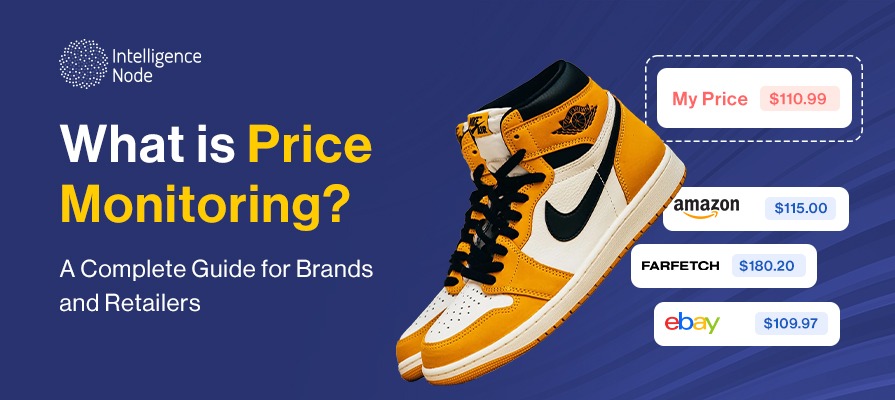
If you sell products online, every price change your competitors make could cost you a customer. Price monitoring means tracking competitor and marketplace prices in real-time, so you can respond quickly and protect your sales. If your prices are too high, shoppers leave. If they are too low, you lose margins. Keeping up with pricing across your category helps you protect revenue and stay visible on key sales channels.
This blog post demonstrates how price monitoring helps brands, retailers, and manufacturers protect margins and improve pricing decisions. You will learn how to use pricing tools to stay competitive and why reacting fast to price changes now matters every day.
Price monitoring is the ongoing process of tracking and analyzing product or service prices across the market to guide smart pricing decisions. Businesses use it to identify competitor moves, follow pricing trends, and determine the right price points for their products.
Most businesses track several types of prices, depending on their category and goals:
In mid‑2022 a U.S.-based outdoor gear retailer called GO Outdoors adopted automated competitor price monitoring services. Their system flagged a major rival’s July 4 tent discount days before it launched. They matched pricing within hours, captured top Amazon search placement, and drove a 32% surge in temporary revenue during that holiday period.
Stories like this are common when businesses use dedicated tools to collect and act on pricing data. Like a consumer price comparison site, a retailer price monitoring tool collects pricing data from websites and marketplaces at regular intervals. These tools then analyze the raw data to highlight competitor prices, pricing shifts, and market-driven patterns based on real-time demand or supply changes.
If you run an online retail business, competitive price monitoring helps you make informed pricing decisions quickly, boost profit margins, and protect long-term brand value.
Price monitoring helps businesses make smarter pricing decisions by tracking competitors, trends, and shifts in real-time. It keeps your prices relevant and stops you from reacting blindly to sudden discounting or promotions in the market.
Here are some of the core benefits of price monitoring:
Informs pricing strategy: With competitor price monitoring services, you get accurate, real-time data collected for informed pricing decisions. By doing this, your team can improve profits and customer trust by adjusting prices based on facts instead of hypotheses.
If you want to react fast to pricing shifts without losing revenue, you need to understand exactly how price monitoring operates behind the scenes.
Price monitoring begins with a structured system that collects, compares, and flags pricing data across different sources. Every step needs to work together so your team doesn’t miss important pricing movements. You can’t act on pricing gaps if your tools can’t spot them in time.
The majority of businesses use web scraping price monitoring tools or marketplace APIs that retrieve data at predetermined intervals to gather competitor pricing. From marketplaces, brand websites, or retailer listings, these tools collect product URLs, prices, and promotions.
Platforms use rules you specify to compare competitor pricing with your current offers after data is gathered. To identify pricing discrepancies and take prompt action, you can set parameters by category, product type, or even region.
Teams monitor pricing across product lines using dashboards and are alerted in real time to any significant changes. Pricing, sales, and marketing teams can use this configuration to make decisions based on factual information rather than intuition.
Manual tracking often uses spreadsheets and individual checks. This makes it hard to catch quick price changes. Automated platforms gather and assess competitor prices on a large scale. They help teams respond more quickly without spending hours on repetitive tasks.
Here’s a quick comparison to help you understand how both methods stack up side by side:
Some businesses update competitor pricing every hour to catch flash sales or limited-time discounts, while others review prices daily or weekly to follow slower-moving markets and seasonal trends. Setting the right monitoring frequency helps balance the cost of data collection with the value of timely pricing insights.
Additionally, regular updates keep your pricing aligned with market trends and help prevent surprise undercutting.
Price monitoring tools help track competitors, correct channel conflicts, and fix revenue leaks before they grow. Each team uses it differently based on what they sell and who they sell to:
Online sales teams rely on price monitoring to watch competitor listings across marketplaces and retailer sites. If a competing brand drops its price during a flash sale, the eCommerce team can quickly match it and retain search visibility on platforms like Amazon or Walmart.
For example, eCommerce teams at Walmart closely watched price changes at Amazon Fresh and Kroger in Denver during 2024 and adjusted pricing within hours. This helped Walmart retain top search rankings and remain within a 6-7% price premium compared to its competitors, significantly improving conversion rates.
Brand leaders use pricing data to track if retailers are respecting MAP guidelines or discounting too aggressively. For example, if a clothing brand finds that one distributor is undercutting prices on a seasonal launch, they can act before the entire market reacts.
Analysts monitor price changes over time to help businesses adjust their margins. For example, someone at a grocery store might check milk or bread prices daily at local competitors to ensure they stay competitive while still making a profit.
These teams focus on broader strategy and use pricing tools to monitor how rival companies price bundles, upsells, and limited-time offers. A fitness equipment brand might spot a competitor dropping rowing machine prices in Q4 and decide whether to follow or focus on ads.
For example, one U.S. chain monitored competitors at scale and optimized dynamic pricing in more than 200 locations, tracking millions of SKUs and adjusting strategy based on competitor behavior
Retailers and wholesalers rely on pricing tools to compare what suppliers offer and how much items are reselling for in the market before placing large orders. If a distributor notices that one supplier’s prices are consistently higher than others, they can switch suppliers to protect their profits. For example, in 2025, a U.S. industrial distributor used GrowByData’s price tools to expand their product range three times and shift from just reacting with discounts to focusing on value-based pricing. This change helped them improve their margins on thousands of products.
Ensure the price monitoring software you select actually enables you to track competitors and respond quickly. You’ll need features that help you move quickly, especially if your catalog is extensive or your prices change frequently.
Accurate product matching capability: Without solid product matching, your comparisons fall apart. Choose software that matches your items to competitor products accurately, whether they’re brand-name or private label.
Tracking prices in retail isn’t as simple as watching a single competitor or looking at one product. Between marketplace pricing shifts and regional variations, most brands struggle to keep up manually.
Below are four specific challenges that teams face when trying to track prices, and how Intelligence Node helps solve them.
Marketplaces like Amazon and Walmart change prices multiple times a day, sometimes every few minutes. Most retailers simply can’t keep up with this pace using internal tracking or spreadsheet-led methods. These rapid shifts cause brands to lose their competitive edge before they even realize it.
Intelligence Node gives you a real-time price monitoring engine that updates every 10 seconds, helping you react before you fall behind. The platform tracks Amazon and Walmart-level changes, recommends pricing moves instantly, and helps you protect margins while staying competitive.
Pricing isn’t consistent across countries, ZIP codes, or even different cities within the same country. Many brands fail to monitor pricing at a local level and miss competitive shifts that affect nearby markets. When teams rely on limited data, they misread customer behavior and make incorrect pricing decisions.
Intelligence Node helps retailers compare and monitor prices locally, globally, and by ZIP code across any currency. The tool’s ML engine lets you benchmark exact matches against competitors in any region without language or format issues.
Old or mismatched data leads to bad pricing decisions and lost revenue across multiple SKUs. Most price tracking tools fail to match similar products correctly or update frequently enough to support pricing moves. One mistake in your source data can cost thousands over time.
Intelligence Node’s patented similarity engine guarantees 99% accurate matches with real-time pricing updates across 1.2 billion SKUs. It gives retailers clean, fresh data they can trust while comparing products across any category at scale.
Retailers often sell bundles, sets, or product variants like size or color options that are priced differently. Most tools can’t identify or match these variations, so teams either ignore them or track them manually. This leads to incomplete pricing insights and missed savings or margin opportunities.
Intelligence Node’s platform automatically detects, separates, and matches bundles and variants with their market equivalents. It tracks and compares bundle prices the same way it tracks single products, helping teams price every option correctly.
Choosing a price monitoring platform depends on your company’s internal setup, user workflows, and long-term goals. You’ll need to evaluate more than features and cost; your tool has to fit how your team works every day.
Below are some of the specific ways different businesses use Intelligence Node’s platform in real time:
To protect its premium positioning, the coffee division of a major global CPG brand needed to monitor retail pricing daily across hundreds of seller sites. They used Intelligence Node to scan for MAP violations in 145 ZIP codes and catch unauthorized discounting by retail partners.
This daily price check helped the brand act before small violations escalated across other locations or sellers. With Intelligence Node, they preserved their pricing policy while protecting brand trust and consistency.
A global hypermarket chain wanted to stay competitive with Amazon across millions of SKUs in real time. With Intelligence Node’s 10-second refresh rate and 99% matching accuracy, the retailer adjusted prices at scale based on live competitor moves.
They used plug-and-play APIs to push pricing data straight into their backend systems without long wait times. This direct integration helped them improve productivity, reduce manual work, and convert shoppers who were comparing prices before making a purchase.
A leading consumer electronics brand needed help identifying gray market sellers that were distorting price perception. They used Intelligence Node’s matching engine to compare products with similar specs across sites and flag unauthorized sellers or wrongly priced listings.
The tool provided them with daily updates on pricing differences across hundreds of SKUs, enabling them to take immediate action. This allowed them to stabilize pricing across global markets and prevent margin leakage caused by underpriced third-party listings.
Retailers who ignore price monitoring leave money on the table and miss clear signs of competitive shifts. Every price drop, stock-out, or promotion from a rival creates a window to win or lose customers. When you track these signals early, you can act quickly, protect profit margins, and gain market share.
Smart brands and retailers use price monitoring tools not just to react, but to lead with better offers. The right solution, such as Intelligence Node, provides pricing clarity, competitive benchmarks, and actionable daily data.Looking for a price monitoring solution tailored to your business? Book a demo with Intelligence Node today!
According to McKinsey, retailers that lead in digital product execution grow 2x faster than their peers. In today’s hypercompetitive market,…
The 2025 holiday season is around the corner. And it comes at a time where economic uncertainty looms over our…
Optimizing the digital shelf means making sure your products show up where shoppers search and buy, especially when you’re leveraging…
We may still be weeks away from the holiday rush, but smart retailers know now is the time to start…
Intelligence Node is proud to be the Official Awards Sponsor for the Women Leaders Summit & Awards India 2025, taking…
Introduction: The Importance of Taxonomy Mapping What is Product Taxonomy? Key Concepts & Definitions Why Marketplaces Differ: Amazon, Walmart, Target…
This website uses cookies.



